
The Microbiome Is Not a Bar Code
The gut microbiome field is quietly moving past composition. Notes from Nutrition 2026 on what that shift looks like.

A session at this year’s American Society for Nutrition annual meeting carried a title built to fill a room: “An Inconvenient Truth? Limited Impact of Diet on Human Gut Microbiota Communities.” It worked. The room was full, and the title did what provocative titles are supposed to do, which is make you show up expecting a fight. What you got instead, if you stayed for all four talks, was something more useful than a fight. You got a redirection.
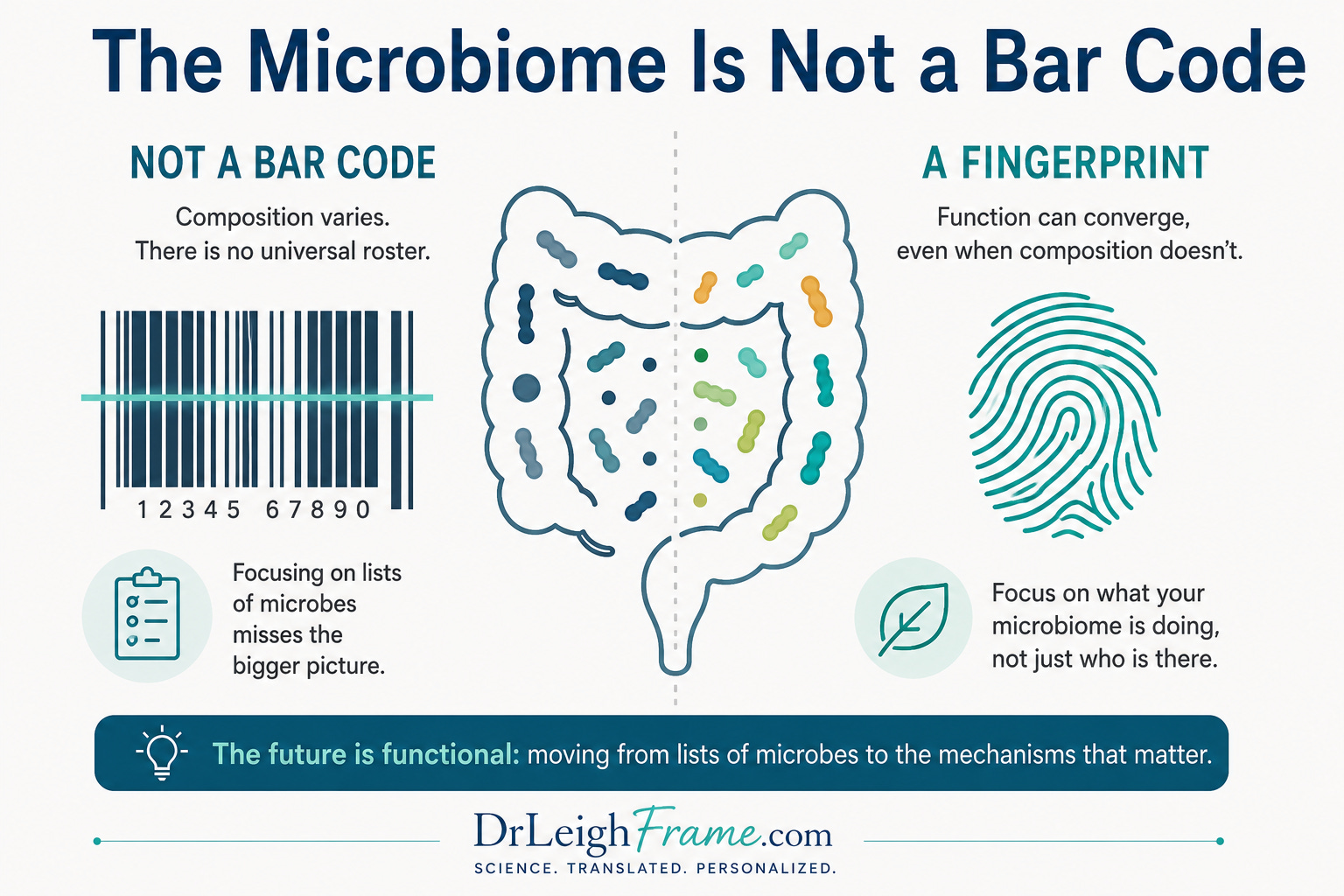
The popular story about the gut microbiome goes something like this. Eat the right foods, and your microbiome shifts toward a healthier configuration. Take the right probiotic, and you seed in the bacteria you were missing. Get the right test, and you find out which species you are low on and correct for it. The whole framework treats the microbiome like a barcode: something that can be scanned, decoded, and checked against a standard inventory of what should be there. Health, on this model, is a matter of getting the scan to match the reference.
What the Session Actually Argued
Hannah Holscher opened the session with a line that could serve as its thesis on its own: there is no definition of a healthy microbiome. Not an incomplete one, not one still being refined. None. If the field cannot yet say what a healthy roster of microbes looks like, then a great deal of commercial microbiome science, the tests that tell you which species you are low on, is answering a question that does not yet have a validated answer key.
Brian Piccolo’s talk showed why composition keeps failing to provide one. In a randomized controlled feeding trial built around the Dietary Guidelines for Americans, fecal microbial diversity did not differ across dietary patterns. Diet changed, composition did not move. But an untargeted metabolomics analysis of the same stool samples successfully discriminated between dietary patterns. The metabolome saw a signal that the taxonomy could not. Piccolo framed the puzzle with a nod to the Anna Karenina principle, the ecological idea that healthy systems tend to resemble each other while disrupted ones fail in their own distinct ways, which is itself a question about whether “healthy” is even a coherent composition to converge on. Tzu-Wen Cross’s talk, following immediately after, reinforced the same point from a different intervention design: putting people through repeated cycles of higher- and lower-quality diets, she found the gut microbiome resilient but not static. Diet nudges specific members. It does not fundamentally restructure the community.
Sean Gibbons closed the session with the clearest answer to what to do with that finding. He opened with an analogy to what he called imprecision medicine: individual responses to common drugs, and to diet, are governed in part by each person’s unique microbiota, the same way antidepressant or reflux medication response varies person to person for reasons that have little to do with the drug itself. His lab’s approach is not to chase a target composition but to model function directly. Using community-scale metabolic models, his group can predict how much short-chain fatty acid, specifically butyrate and propionate, a person’s gut community will produce, and the prediction holds up even though the underlying species doing the producing differ substantially from person to person. Composition varies. The functional prediction does not need it to converge. That is the fingerprint problem solved in practice rather than just diagnosed: you stop trying to define a healthy roster and start predicting a healthy output, regardless of which organisms are supplying it.
The Same Question, a Different Session, a Different Answer
Piccolo’s null result on composition was not the last word on the question, even at the same meeting. Two days later, in an entirely different session chaired by my GW colleague Carmen Ortega-Santos, Noel Mueller presented DASH4D, a randomized crossover feeding trial in roughly 100 adults with type 2 diabetes, comparing a DASH diet modified for diabetes against a typical American diet. Here composition did move: the modified diet increased microbial evenness and shifted overall community composition. Function moved with it. Butyrate-producing species increased, including Faecalibacterium prausnitzii, along with a 12 percent rise in the abundance of the gene for butyryl-CoA:acetate CoA-transferase, the terminal step most gut bacteria use to actually produce butyrate, and plasma butyrate itself rose.
In Mueller’s trial, compositional and molecular functional measures moved together, and the mechanism was specific: a named gene, a named butyrate-producing species, plasma butyrate itself. In Piccolo’s, taxonomy remained comparatively uninformative while the fecal metabolome still registered the dietary contrast, though that metabolome reflects some mix of microbial metabolism, host metabolism, and diet residue rather than a verified microbial signal on its own. The two talks are not mirror images of each other so much as two different ways composition alone came up short.
Two rigorous controlled feeding trials, presented at the same meeting, produced different answers to the question of whether diet measurably changes microbiome composition. That does not make either result anomalous. The populations, diets, and study designs were different, and a reliable biological readout can legitimately vary by intervention, disease state, and baseline microbiome. But it does underscore why composition alone has not yielded a simple or generalizable account of how diet affects the gut microbiome.
The Fingerprint Problem
This distinction sounds academic until you follow it to its actual implication, which is close to disqualifying for a large share of commercial microbiome science. If a gut microbiome is genuinely as individual as a fingerprint, meaning that no two people’s microbial communities look alike even under similar diets and similar health status, then the premise of defining a healthy microbiome by its composition becomes very hard to justify. A fingerprint has no reference configuration to match against. There is no universal healthy fingerprint, only the fact that every fingerprint is different. Try to define health as a composition target on top of that kind of variability, and you are chasing something that was never going to converge.
Function offers a more tractable level at which to evaluate what a microbial community may be doing for, or to, its host, even when the organisms producing those outputs differ, and Gibbons’s short-chain fatty acid models are a working demonstration of that rather than a hypothetical one. Two people with almost no bacterial species in common can still produce similar volumes of the same metabolites, the same downstream signals to the gut lining and the immune system and, increasingly, the brain. The output can look similar even when the roster producing it looks nothing alike. That does not mean a single functional target, more butyrate, more of a given metabolite, is automatically healthier in every context; the relevance of any metabolite still depends on concentration, location, absorption, and the surrounding metabolic network. But the field may be better able to define health through patterns of function and host response than through a universal taxonomic roster.
I have made a version of this argument before, in other contexts and about other layers of nutritional science: the field keeps building proxies and mistaking them for the mechanisms underneath. The four talks in that ASN session were, each in their own way, the same argument in miniature: composition is a proxy, and it was time to ask what it was standing in for.
More Complications
My own lab’s work, presented at the same meeting, makes the same point from another angle. Our bMicrobiome Study compared cognitively healthy older adults to those with mild cognitive impairment and found no statistically significant difference in overall microbial composition between the groups. What signal did emerge was driven largely by microbial dark matter, taxa too poorly characterized to classify. The result illustrates a basic interpretive problem: even when compositional differences appear, their biological meaning remains difficult to establish when much of the signal comes from organisms current databases cannot adequately characterize.
A poster from a separate group at Oregon State complicates the picture in the other direction: composition genuinely did shift. In a twelve-week trial led by Emily Ho, director of the Linus Pauling Institute, and Laura Beaver, comparing a daily almond snack to a cracker control in adults with metabolic syndrome, the abundance of one bacterial group tracked with the greatest improvements in cholesterol, a real compositional finding, on top of already-published improvements in total and LDL cholesterol and intestinal inflammation. But the researchers’ own next step is untargeted metabolomic profiling to find out what that bacterial group is actually producing, and the one outcome that was not a composition measure at all, a class of anti-inflammatory lipid metabolites, also rose in the almond group. Even in a study built around a compositional headline, the explanatory work is being chased at the level of function.
A poster presented at the same meeting, which I did not see in person but found compelling enough in the abstract to include, adds a further wrinkle by putting a time axis on the same divergence. Researchers tracking 828 adults in a coastal Chinese cohort over four years, with quarterly sampling across a full seasonal cycle, found that the plasma metabolome and the gut microbiome responded to season on very different timelines. The metabolome showed real seasonal movement, but resilience: it returned to baseline after a complete cycle. The microbiome showed the opposite pattern, a slower temporal drift that did not return to where it started. The divergence between composition and function is not only a between-person problem, the fingerprint issue the ASN session raised. It is also a within-person, over-time problem. A single microbiome snapshot may not even be comparing a person to themselves in any stable sense, let alone to a population standard.
What This Means
It means the field is in the middle of relocating its central question, from what is present to what is happening. That is a harder question to answer, because it requires moving beyond taxonomic sequencing toward direct or better-validated measures of microbial activity: metabolomics, metatranscriptomics, metaproteomics, experimental assays, and models that can be tested against observed outputs, not sequencing alone, and it is a slower, more expensive kind of research to run. But it is the right question, and the fingerprint problem is exactly why. You cannot define health as a target composition when there is no shared composition to target. Patterns of function and host response, imperfect and context-dependent as they still are, look like a more tractable place to look than a universal taxonomic roster.
Nutrition 2026 left me thinking the microbiome field is undergoing a familiar transition in nutrition science: away from convenient proxies and toward the mechanisms those proxies only imperfectly represent. Sequencing made composition easy to measure. The harder question, what these communities are actually doing and how the host responds, is increasingly the one that matters, whether you are a clinician interpreting a stool test or someone holding a consumer microbiome report.
We may eventually learn to read the fingerprint itself more intelligently. For now, the honest state of the science is that it is worth spending less effort trying to scan the microbiome like a barcode against a reference inventory, and more effort understanding what it produces. A composition report tells you who showed up. It does not yet reliably tell you what they are doing, and what they are doing is where the real story increasingly appears to be.